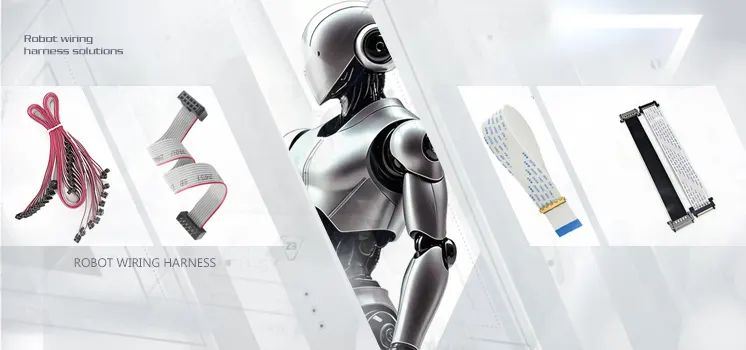
Robot Wire Harness Manufacturer for Industrial Automation

We engineer fully custom high-flex robot cable assemblies built for continuous torsion, drag chain travel and millions of flex cycles.Supporting full development from prototype validation to high-volume mass manufacturing.

Kaweei custom robot wire harness solutions

Get a Quote for Your Robot Wire Harness

Send your requirements, our engineering team will provide a detailed quote within 24 hours.

What Is A Robot Wire Harness?

Standard general-purpose cables cannot withstand the repeated bending, torsion and EMI interference inside robotic arms and drag chain equipment. Below we clarify the definition of dedicated robotic wiring harnesses and their core technical advantages to solve your production downtime risks

What Is A Robot Wire Harness?

A robot wire harness is a custom flexible cable assembly built exclusively for industrial robotic arms, servo drive systems, AGVs and automated motion control equipment.
It is engineered to endure millions of repeated drag chain cycles, continuous joint torsion and long-term dynamic bending inside production lines. Unlike ordinary industrial wiring that quickly fractures under frequent movement, robotic harnesses eliminate unplanned equipment downtime and reduce frequent cable replacement maintenance costs for automated workshops.

Key Differences from Standard Industrial Cables

  • Flex Life: Up to 10+ million bending cycles; avoids frequent cable breakage caused by robotic joint continuous motion, cutting production halt risks.
  • Multi-Layer EMI Shielding: Foil + braided double shielding structure; blocks servo motor signal interference to prevent positioning errors and equipment malfunction.
  • Class 6 High-Strand Conductor: Ultra-fine multi-strand copper core, far softer than standard conductors; resistant to fatigue fracture under long-term torsion.
  • Compact Micro Connector Layout: Miniature high-density connectors tailored for narrow robotic joint space, neat wiring without assembly interference.
  • IP67+ Environmental Durability: Waterproof, dustproof and oil-resistant insulation; adapts to harsh workshop cutting fluid, dust and temperature fluctuation environments.

Core Robotic Wiring Solutions

From heavy-duty six-axis robotic arms to compact cobot vision units and warehouse mobile AGVs, we deliver custom high-flex robotic wire harnesses matched to the unique cyclic motion, shielding and abrasion demands of every automation segment.

Custom high-cycle flexible cable assemblies

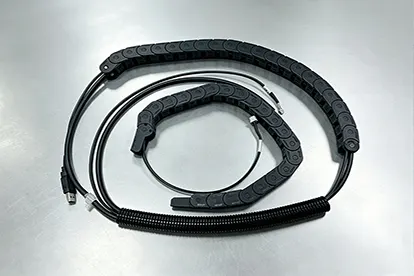
6-Axis Industrial Robots

Custom high-cycle flexible cable assemblies built for servo motor power wiring, motion control signal transmission and long-stroke drag chain routing on heavy-duty industrial robotic arms. Designed to withstand continuous joint torsion and repeated bending inside production workshops.

Key Requirements: Over 10 million flex cycle lifespan
Typical Use: Automotive assembly, metal machining.
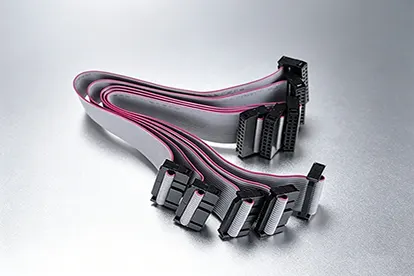
Flexible Ribbon Cable for Robots

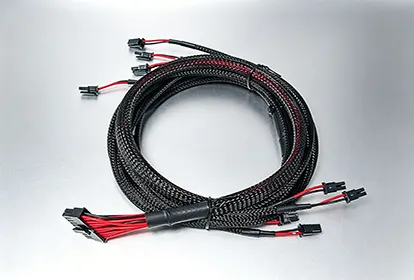
Robot & Machine Vision Wiring Assemblies

Lightweight, low-profile shielded harnesses for human-collaborative robot joints and high-speed machine vision cameras/laser sensors. Multi-layer EMI shielding eliminates signal interference for precise positioning and image data transmission in shared workspace environments.

Key Requirements: 90% Shielding Coverage
Typical Use: Light Assembly and Inspection Line
AGV & AMR Mobile Robot Cable Harnesses

AGV & AMR Mobile Robot Cable Harnesses

Heavy-duty abrasion-resistant power & composite data cable assemblies for autonomous warehouse transport robots. Optimized for repeated horizontal drag chain travel, frequent start-stop movement and dusty logistics workshop conditions.

Key Requirements: High abrasion & IP67/68 Waterproof
Typical Use: Warehouse Automation Infrastructure

Core Challenges In Robotics Wiring

Robotic automation brings unique mechanical & electromagnetic wiring obstacles. Below we break down the 3 core pain points of robotic harness operation and our targeted custom manufacturing solutions to eliminate premature cable failure & signal faults.

Dynamic Bending & Torsion

Pain point:Robotic joints run millions of bending & torsion cycles; ordinary standard cables crack and fail frequently, triggering unplanned production downtime.

Custom Solution

We manufacture harnesses with high-strand Class 6 conductors, aramid fiber reinforcement and wear-resistant PUR/TPE jackets, supporting over 10 million cyclic service life.

EMI Interference

Pain point:Servo drives and multi-bus communication generate heavy electromagnetic interference, distorting sensor & camera signal data.

Custom Solution

Multi-layer foil + tinned copper braided shielding with precise impedance control, stabilizing high-speed signal transmission for automated vision & motion control.

Space Constraints

Pain point:Compact robot joint structure leaves limited internal space, requiring dense wiring without sacrificing flexibility.

Custom Solution

Micro-density customized assembly supported by 3D routing simulation, matching miniature connectors down to 1.25mm pitch or less for narrow installation space.

Technical Specifications

The table below lists fixed standard performance parameters for our custom robot wire harnesses, covering flex life, torsion resistance, temperature range and industrial compliance to resolve the core robotic wiring challenges above

Parameter Specification
Flex Life >10 million cycles (bending/torsion)
Bend Radius 5×OD (dynamic drag chain) / 7.5×OD (static standard routing)
Torsion Resistance Max torsion: ±360° over 0.5m length, or ±180° per meter of cable
Temperature Range -40°C to +120°C (modified high-temp PUR) / up to +125°C (special TPE/silicone grades)
Shielding Double-layer Foil + Braid shielding (>85% braid coverage)
Voltage Rating Up to 600V (low-voltage servo power & high-speed signal circuits)
IP Rating IP67 (standard finished harness) / IP69K (optional heavy washdown version)
Compliance IPC/WHMA-A-620 Class 3 industrial assembly standard

Key Project Information to Prepare for Custom Robotic Harness Quotation

As your OEM custom wire harness manufacturer, our engineering team provides free DFM review, structural optimization and full-process production validation. To deliver precise drawings, cost quotes and reliable manufacturing schemes faster, please prepare the below core technical requirements when submitting your project demand

Conductor & Electrical Requirements

Please confirm required wire gauge, rated voltage, continuous current load and signal type (power / encoder / vision data). For dynamic robotic movement, specify target flex cycle life to match our Class 6 high-flex conductor design.

Connector Matching Requirements

Supply target connector brand, model, pin pitch and total mating cycles. For compact cobot/joint installation, note micro-connector size limits; we add dedicated strain relief structures to avoid terminal breakage during repeated motion.

EMI & Shielding Standards

Inform us of your workshop EMI environment strength and signal anti-interference demands. We offer single-layer or double foil-braid shielding customized according to your communication bus stability requirements.

Operating Environment Parameters

Provide long-term working temperature range, chemical exposure (cutting fluid / oil), abrasion conditions and required IP protection grade (IP67 / IP69K). We select matching PUR/TPE outer jacket materials for drag chain & outdoor robotic equipment.

Full DFM case studies, long-cycle flex test data and custom harness reference drawings are available in our resource articles for further reference.

Robot Wire Harness FAQ

What is the flex life of your robotics wire harnesses?

Our high-flex robotics wire harnesses use premium continuously flexible cables rated for 5 to 20 million bending cycles. Reinforced strain-relief designs ensure long-term reliability in robotic arms, automated equipment and continuous-motion applications.

Do you provide lightweight and compact wire harnesses for robotic arms?

Yes. We use fine-strand conductors, compact connectors and optimized cable routing to minimize weight and installation space, making our wire harnesses ideal for articulated robots, collaborative robots and end-of-arm tooling.

Can you manufacture custom robotics wire harnesses from our drawings or samples?

Yes. We manufacture custom robotics wire harnesses from CAD drawings, 2D/3D models, BOMs and physical samples. Our engineering team reviews every project to improve manufacturability, reliability and production efficiency.

How do you ensure reliable signal transmission in robotic applications?

We use high-quality shielded cables, precision termination and optimized cable routing to minimize electromagnetic interference (EMI), ensuring stable power and signal transmission for servo motors, encoders, sensors and robotic control systems.

What testing and quality inspections do you perform?

Every robotics wire harness undergoes comprehensive in-house testing, including continuity testing, insulation resistance, Hi-Pot testing, terminal pull-force testing and connector retention verification before shipment.

Can you source approved connector and cable brands?

Yes. We source components according to your Approved Vendor List (AVL). We support leading brands such as TE Connectivity, Amphenol, LEMO, Molex, JST, Alpha Wire and Belden through authorized distributors including DigiKey and Mouser.

Do you provide prototype robotics cable assemblies?

Yes. We offer rapid prototype manufacturing for robotics wire harness and cable assembly projects, helping customers validate mechanical fit, electrical performance and system integration before mass production.

Do you support OEM and ODM robotics wire harness projects?

Yes. We provide complete OEM and ODM robotics wire harness manufacturing services, including engineering support, DFM analysis, prototype development, mass production and 100% electrical testing for robotics and automation equipment manufacturers worldwide.

Our Commitment to Quality

IPC/WHMA-A-620 Class 3 Certified
ISO 9001:2015 Quality Management
100% Electrical Testing
Dynamic Flex - Cycle Validation