
1. Why "Quality" Is the Watershed in Wire Harness NPI
In the New Product Introduction (NPI) process for custom electronic wire harnesses, engineering teams are most often stalled not by "can it be made", but by "whether the sample meets the customer's functional quality requirements, whether validation data is usable, and whether it can seamlessly transition to mass production".
Many suppliers in the industry blindly pursue extreme fast sampling, sacrificing process standards, performance testing, and compliance verification. While delivery appears fast, it leads to a serious disconnect between samples and mass production. Subsequent mass production stages frequently encounter batch quality issues such as poor insulation, waterproof failures, and vibration loosening, directly causing project delays, skyrocketing rework costs, and blocked customer project acceptance.
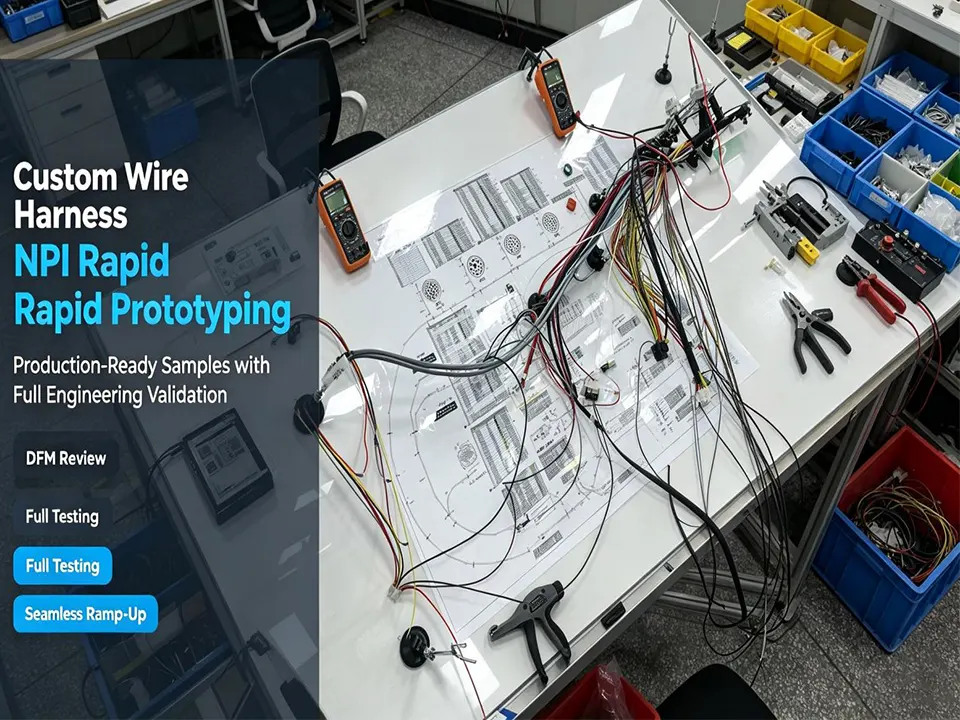
The core value of true engineering-level NPI rapid prototyping is not "fast sampling", but bringing design risks, manufacturing risks, compliance risks, and mass production risks all forward to the sample stage, avoiding batch quality issues after mass production tooling and volume production.
Since 2013, Kaweei has been deeply engaged in custom wire harness NPI engineering services, serving global multi-industry OEM customers, turning "rapid prototyping" into a committable, traceable, and replicable engineering capability.
2. Ordinary Handmade Samples VS Mass-Production-Grade NPI Validation Samples
Most wire harness manufacturers' rapid prototyping is merely appearance-fit handmade samples: only matching interface dimensions, without process solidification, full-scope performance validation, or alignment with mass production standards. Such samples can only be used for temporary assembly verification, cannot represent mass production quality, and lack data support for crimping reliability, insulation stability, waterproof durability, and vibration resistance. Batch defects are highly likely to emerge after volume production.
Kaweei NPI rapid prototyping delivers mass-production-source-consistent validation samples, strictly following APQP front-loading control logic. Samples and mass production share unified standards: tooling, production SOPs, test specifications, and quality judgment criteria are completely consistent, truly achieving sample validation results = mass production quality benchmark.
When engineering procurement and R&D select suppliers, they can focus on verifying three quantifiable capability standards:
Response Time: Engineering review, DFM risk analysis, and quotation within 8 to 12 hours after RFQ submission
Delivery Lead Time: Tiered delivery based on sample complexity, with transparent timelines and no hidden delays
Validation Completeness: Samples 100% completed with electrical, mechanical, environmental, and compliance full-scope testing, accompanied by complete test reports
The delivery foundation of wire harness products revolves around three core points: speed, price, quality. If these three core points must be satisfied simultaneously during the NPI rapid prototyping stage, there is a fundamental contradiction. Kaweei consistently prioritizes quality anddelivery speed, with price merely reflecting the equivalent return for our service value.
3. Kaweei Wire Harness NPI Five-Step Standardized Engineering Process
The entire NPI process is built around "validate design, finalize process, eliminate hidden risks, establish standards, and seamlessly transition to mass production", with each stage clearly addressing customer requirements.
Stage 01 Precise Requirement Deconstruction and Operating Condition Alignment
Engineering Execution Actions: Professional sales personnel engage with customers, aligning requirements from four dimensions: application scenarios, environmental specifications, compliance requirements, and target cost:
Deliverables: Project requirement confirmation form, preliminary material risk assessment, compliance requirement checklist
Coverage Alignment Dimensions:
Scenario Dimensions: Automotive EV/BMS/ADAS/in-vehicle instruments, industrial PLC/servo/CNC, medical monitoring and diagnostic equipment, robotics, energy storage cabinets, telecom/data center equipment
Environmental Dimensions: High/low temperature tolerance, chemical corrosion, IP67/IP68 waterproof and dustproof, EMI/EMC electromagnetic compatibility, UV aging resistance, flame retardancy ratings
Compliance Dimensions: UL, IEC, CE, RoHS2.0/REACH, IATF16949, ISO13485 industry compliance standards
Cost Dimension: BOM target cost, product full-lifecycle cost control
Stage 02 Engineering Design + DFM Manufacturability Review + Tooling Solution Finalization
Engineering Execution Actions: Cross-functional review involving structure, hardware, process, and procurement departments, delivering manufacturable solutions based on APQP process; identify long-lead-time and EOL discontinued materials, prepare alternative solutions; complete mold, tooling, and process optimization upfront.
Deliverables: 2D/3D engineering drawings, standardized BOM list, DFM risk review report, tooling design proposal, detailed cost breakdown
Stage Outcome: Complete manufacturability optimization of drawings, eliminate structural design risks, finalize materials and tooling solutions.
Stage 03 Dedicated Production Line Rapid Prototyping and Initial Inspection
Engineering Execution Actions: Dedicated NPI rapid prototyping line, not occupying mass production capacity; maintain inventory of mainstream brand wires and connectors such as TE, JST, Molex, Amphenol, LEMO; fully automatic equipment completes wire cutting, stripping, crimping, soldering, and molding all processes.
Deliverables: Process operation records, semi-finished product inspection records, sample preliminary inspection report
Stage Outcome: Complete mass-production-grade prototype physical delivery, basic process parameter validation passed.
Tiered Transparent Delivery Lead Times (no absolute commitments, compliant with overseas customer audit standards):
Simple cable assemblies: 24–48 hours
Standard conventional wire harness samples: 72 hours
Complex multi-core, multi-connector, overmolded wire harnesses: 5–10 working days (adjusted according to tooling development and material supply status)
Stage 04 Pilot Run Validation & Seamless Mass Production Transition
Engineering Execution Actions: Validate process stability through Pilot Run; finalize standardized SOP work instructions; implement SPC statistical process control to monitor critical process parameters; complete supply chain delivery capability verification; support multiple sample version iterations for different validation scenarios.
Deliverables: Pilot run summary report, mass production SOP documents, SPC parameter baseline table, material delivery confirmation report
Stage Outcome: Production process finalized, sample process can be directly transferred to mass production without secondary development.
Stage 05 Full Lifecycle Quality Control and Traceability System
Engineering Execution Actions: Implement IQC incoming material inspection, IPQC regular in-process inspection, OQC outgoing quality inspection; leverage MES system for full batch traceability of materials, processes, equipment, and personnel; 100% electrical performance full inspection before all samples are shipped.
Quality Execution Standards: Follow IPC/WHMA-A-620, MIL-STD-105E inspection specifications, AQL quality judgment: critical defect CR=0, major defect MA=0.4, minor defect MI=0.65.
Deliverables: IQC/IPQC/OQC inspection records, complete performance test reports, MES batch traceability documents
Stage Outcome: All samples are verifiable, traceable, and reproducible, meeting high-end OEM compliance audit standards.
5. Required Documentation List for Initiating Wire Harness NPI Prototyping
Customers are not required to gather all documents; submitting any single item can initiate the evaluation. If documentation is incomplete, reverse modeling + engineering file creation is supported to complete drawings and BOM lists.
2D engineering drawings / 3D CAD models
BOM bill of materials
Precise connector and terminal part numbers
Wire specifications and electrical parameter requirements
Physical samples, actual photos, hand-drawn design sketches
Equipment application scenarios and operating condition requirements
High/low temperature, waterproof, vibration and other environmental usage requirements
Customized testing and industry compliance certification requirements
6. Complete Mass-Production-Grade Test Validation System
All test items are executed based on product specifications, customer validation requirements, and corresponding industry IEC/UL/IPC standards.
| Test Item | Execution Standard | Test Execution Description |
| Continuity Test | IPC/WHMA-A-620 | 100% full inspection, checking for open circuits, miswiring, and loose connections |
| Insulation Resistance Test | IPC/WHMA-A-620 | 500VDC/1000VDC testing based on product specifications to determine insulation performance compliance |
| Hi-Pot Dielectric Strength Test | UL 486A, IEC 60598-1 | Test voltage, duration, and leakage current thresholds set according to product specifications and industry safety standards, suitable for low-voltage and medium-to-high-voltage wire harness scenarios |
| Terminal Crimp Pull Force Test | IPC/WHMA-A-620 | Pull force threshold determined by wire cross-sectional area; test data linked to mold number for process traceability |
| IP67/IP68 Waterproof Air Tightness Test | IEC 60529 | Differential pressure method testing, with pressure and duration set according to product sealing structure to verify waterproof reliability for outdoor and internal equipment use |
| Temperature and Humidity Cycling Test | IEC 60068-2-30 | Simulate damp heat and alternating temperature/humidity conditions to verify wire harness aging resistance and moisture resistance |
| Thermal Shock Test | IEC 60068-2-14 | Rapid high-low temperature switching cycles to verify wire harness structure, insulation, and terminal resistance to temperature shock |
| Vibration Test | IEC 60068-2-6 | Simulate automotive and industrial equipment vibration conditions to verify wire harness resistance to loosening and fracture |
| RoHS2.0/REACH Compliance Testing | EU 2015/863 | XRF equipment sampling + supply chain compliance declarations to ensure material environmental compliance |
7. Traditional Supplier VS Kaweei NPI Engineering Model Comparison
| Comparison Dimension | Traditional Wire Harness Supplier | Kaweei NPI Engineering Service Model |
| Engineering Review Capability | Only checks basic dimensions, no systematic DFM risk assessment | Full-scope DFM manufacturability review, proactively avoiding design and process risks |
| Sample Quality Standard | Simple handmade samples, not made with mass production processes | Mass-production-source-consistent process, samples are the mass production benchmark |
| Test Validation Capability | Only basic continuity testing, no environmental or mechanical performance validation | Electrical, mechanical, environmental, and compliance full-scope closed-loop validation |
| Deliverable Documentation | Scattered data, no standardized reports or process documents | Complete DFM reports, test reports, SOP process documents, traceability records |
| Mass Production Transition Capability | Samples and mass production processes are disconnected, requiring secondary development and debugging | Process, tooling, and test standards are directly reusable, seamless transition to mass production |
8. Frequently Asked Questions (FAQ)
Q1: Can NPI samples directly transition to mass production seamlessly?
Yes. Kaweei NPI samples are made with mass-production-source-consistent tooling, processes, and test standards. The finalized SOPs, mold parameters, and test programs can be directly reused without secondary development and debugging, significantly shortening the mass production ramp-up cycle.
Q2: If we don't have drawings, only samples or sketches, can you make prototypes? Can you help produce complete wire harness drawings?
Yes. Based on customer physical samples, hand-drawn sketches, or fragmented specifications, we can reverse-engineer 2D/3D modeling, establish BOM documentation, and implement a standardized NPI prototyping process.
Q3: Is there a minimum order quantity (MOQ) requirement?
No MOQ limit. Sampling starts from 1 piece, and the same dedicated engineering team handles both sample development and subsequent mass production.
Q4: Can you provide test and OQC inspection reports?
9. Initiate Your NPI Project
The core value of high-quality wire harness NPI prototype samples is not just rapid delivery, but minimizing R&D uncertainties and batch quality risks before mass production investment.
Whether you have complete drawings and BOM lists, or only physical samples, hand-drawn sketches, and fragmented specifications, the Kaweei engineering team can provide free NPI feasibility assessment, DFM risk review, and accurate lead time and cost estimation.
Submit your drawings, BOM, connector part numbers, or physical samples, and receive a professional engineering review and quotation within 24 hours.


