
Do you often hear these two expressions?
Harness Engineer A says: 'Get me a 4-square wire.'
Harness Engineer B says: 'This is a 12 AWG wire.'
What exactly do these expressions mean? Why does one say 'square' and the other say 'AWG'? Does a larger number mean the wire is thicker or thinner? If a 12 AWG wire on a customer's drawing is replaced with 4 mm², can it be used directly?
These questions are actually very common in custom wire harnesses. Especially on drawings from European and American customers, AWG is often used directly, while the domestic supply chain and many Chinese factories are more accustomed to using mm² to describe conductor specifications. So when doing harness quotations, BOM confirmation, or material substitution, the relationship between AWG and mm² often needs to be re-verified.
I. Two Common Standards: AWG and mm²
The thickness of a wire is not expressed the same way all over the world. The two most common systems we encounter are the metric mm² and the US AWG.
The first is the metric specification, which we usually refer to as 'how many squares'.
For example, 0.75 mm², 1.5 mm², 2.5 mm², 4 mm². Here, mm² refers to the nominal cross-sectional area of the conductor, so its logic is very intuitive: the larger the number, the larger the conductor cross-section, and generally the thicker the conductor.
For example, a 4 mm² conductor is definitely thicker than a 1.5 mm² conductor.
This way of specifying conductor size by cross-sectional area is very common in the IEC system and in markets such as China and Europe.
The other is AWG, which stands for American Wire Gauge.
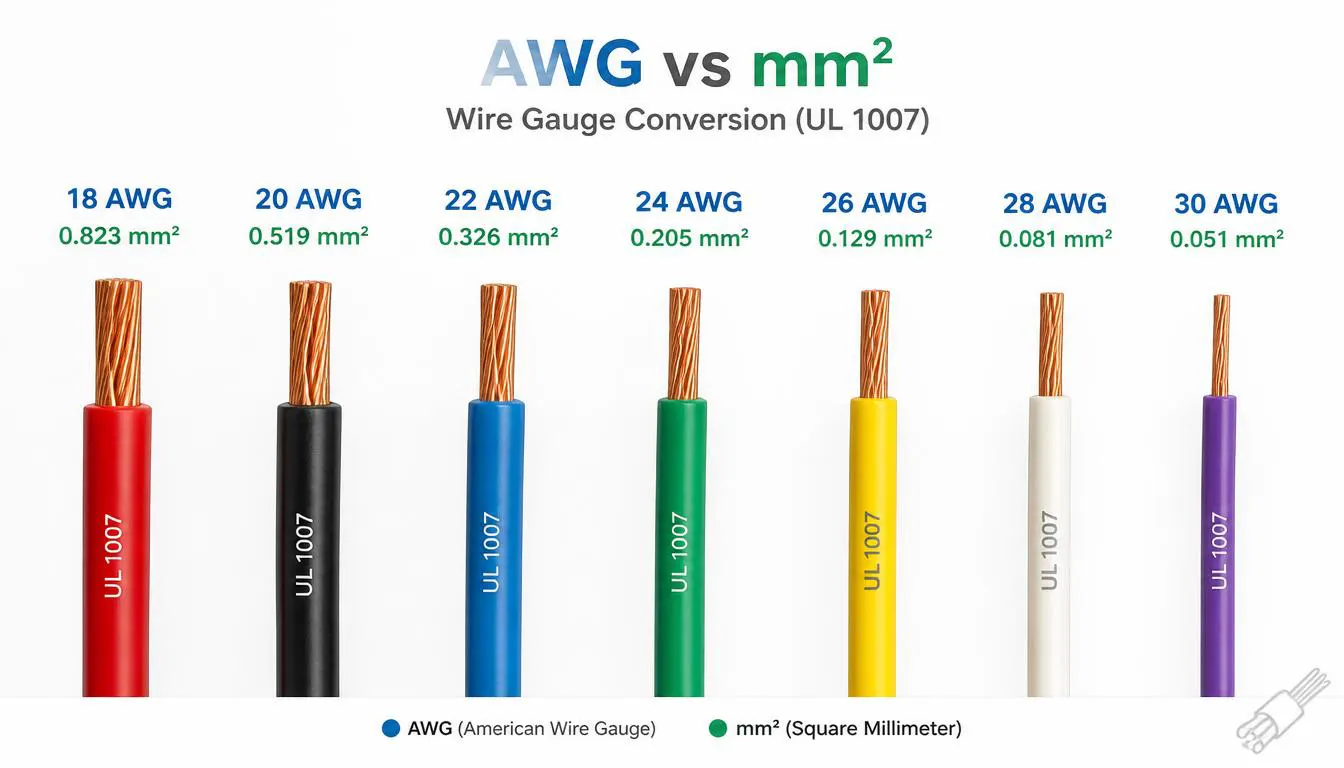
The logic of AWG is exactly the opposite of mm²: The smaller the AWG number, the thicker the wire; the larger the number, the thinner the wire.
So 12 AWG is thicker than 18 AWG, and 18 AWG is thicker than 24 AWG.
When looking at an American customer's drawing for the first time, this is where it's easiest to get confused. Because according to our usual numerical habit, it's easy to think that '18' should be thicker than '12', but it's actually the opposite.
Like modern cable standards, AWG is a standard system formed through long-term industrial development. It is related to early American wire processing, gauges, and drawing processes, and was gradually standardized into the AWG specifications used today. It should be noted that the AWG number cannot be simply interpreted as how many times the wire has actually been drawn. It is essentially a fixed gauge size system, where each AWG corresponds to a specific conductor diameter and cross-sectional area.
AWG also has an interesting rule: For every 6 AWG numbers increase, the conductor diameter roughly halves, and the cross-sectional area becomes 1/4; for every 3 numbers increase, the cross-sectional area roughly halves. So AWG is not a simple arithmetic progression.
II. How Many Square Millimeters is an AWG?
Once you know the difference between the two systems, the real practical question arises:
How many mm² is 12 AWG?
The answer is: The nominal conductor cross-sectional area of 12 AWG is approximately 3.31 mm².
Special attention is needed here: 3.31 mm² is close to our common 4 mm², but you cannot directly conclude that:
12 AWG = 4 mm².
They are two different specifications, though they are often compared in engineering practice.
If you just need a quick reference, the table below is more convenient. I've put together the conductor diameter, cross-sectional area, and the closest metric specification for AWG 0-32.
| AWG | Conductor Diameter (mm) | Conductor Area (mm²) | Closest Metric Spec |
|---|---|---|---|
| 0 | 8.25 | 53.49 | 50 |
| 1 | 7.35 | 42.41 | 50 |
| 2 | 6.54 | 33.62 | 35 |
| 3 | 5.83 | 26.67 | 25 |
| 4 | 5.19 | 21.15 | 25 |
| 5 | 4.62 | 16.77 | 16 |
| 6 | 4.11 | 13.30 | 16 |
| 7 | 3.67 | 10.55 | 10 |
| 8 | 3.26 | 8.37 | 10 |
| 9 | 2.91 | 6.63 | 6 |
| 10 | 2.59 | 5.26 | 6 |
| 11 | 2.30 | 4.17 | 4 |
| 12 | 2.05 | 3.31 | 4 |
| 13 | 1.83 | 2.63 | 2.5 |
| 14 | 1.63 | 2.08 | 2.5 |
| 15 | 1.45 | 1.65 | 1.5 |
| 16 | 1.29 | 1.31 | 1.5 |
| 17 | 1.15 | 1.04 | 1.0 |
| 18 | 1.02 | 0.823 | 1.0 |
| 19 | 0.912 | 0.653 | 0.75 |
| 20 | 0.812 | 0.519 | 0.5 |
| 21 | 0.723 | 0.410 | 0.5 |
| 22 | 0.644 | 0.326 | 0.35 |
| 23 | 0.573 | 0.258 | 0.25 |
| 24 | 0.511 | 0.205 | 0.20 |
| 25 | 0.455 | 0.162 | 0.20 |
| 26 | 0.405 | 0.129 | 0.14 |
| 27 | 0.361 | 0.102 | 0.10 |
| 28 | 0.321 | 0.0804 | 0.08 |
| 29 | 0.287 | 0.0647 | 0.06 |
| 30 | 0.255 | 0.0509 | 0.05 |
| 31 | 0.227 | 0.0401 | 0.04 |
| 32 | 0.202 | 0.0324 | 0.035 |
The 'closest metric spec' in the table is only to help engineers make a quick assessment, not to imply that the two specs can be directly interchanged. For example, 12 AWG is 3.31 mm², the common close spec is 4 mm², but if the customer drawing clearly specifies 12 AWG, in actual production you still need to verify the wire, terminals, connectors, and relevant standards, and cannot simply substitute materials based on this table.
For even easier lookup, here are some of the more common specifications in harness projects listed separately:
| AWG | Conductor Area | Closest Metric Spec | Common Application |
|---|---|---|---|
| 18 AWG | 0.823 mm² | 1.0 mm² | Control, sensors, small harnesses |
| 16 AWG | 1.31 mm² | 1.5 mm² | Control, power |
| 14 AWG | 2.08 mm² | 2.5 mm² | Power, industrial equipment |
| 12 AWG | 3.31 mm² | 4 mm² | Power, battery harnesses |
| 10 AWG | 5.26 mm² | 6 mm² | Higher current power |
| 8 AWG | 8.37 mm² | 10 mm² | Battery, power connections |
| 6 AWG | 13.30 mm² | 16 mm² | High current connections |
| 4 AWG | 21.15 mm² | 25 mm² | Battery, high current power |
If we broadly categorize by application, AWG can be divided into three common ranges. Smaller AWGs are more common in signal, control, sensor, and precision electronics; mid-ranges are often used inside equipment, power, and general industrial harnesses; larger conductors are more common in batteries, power supplies, and high-current connections.
| Spec Range | Common Application | Key Selection Factors |
|---|---|---|
| 20–32 AWG | Signal, sensors, electronics | Signal integrity, voltage drop, flexibility, connectors |
| 10–18 AWG | Control, power, industrial equipment | Current capacity, temperature rise, voltage drop, terminals |
| 0–8 AWG | Batteries, power supplies, high-current equipment | Ampacity, temperature rise, voltage drop, mechanical strength |
Of course, this is just for general understanding. You shouldn't select a fixed AWG just because a product falls under 'power cable'.
III. Why Does Choosing the Wrong Wire Gauge Cause Problems?
The real importance of wire gauge isn't the number itself, but how it ultimately affects resistance, temperature rise, and voltage drop.
The thinner the conductor, the higher the resistance, all other things being equal. When higher current flows through the conductor, the heat generated by resistance increases, with the basic relationship being Q = I²R.
So if you use a significantly undersized wire for a high-current load, the first issue you'll likely encounter is overheating. The higher the current, the more obvious the problem. Under long-term operation, the temperature rise may exceed the allowable range of the wire insulation material, eventually causing aging, deformation, or even insulation failure.
Another issue is voltage drop. Especially over long cable runs, the conductor resistance causes a portion of the voltage to be lost along the line. When the voltage at the equipment end drops, you may experience startup issues, insufficient power, or unstable operation.
So the wire gauge isn't simply 'the thicker the better', nor is it 'as long as it conducts electricity, it's fine'. What's really needed is to select the appropriate specification based on current, length, temperature, installation method, and operating environment.
IV. How to Choose the Wire Gauge for a Custom Wire Harness?
When it comes to custom harnesses, the AWG to mm² conversion is just the first step.
For example, the customer tells us:
24V, 15A, cable length 2 meters.
We first need to know the load current, and then consider cable length, voltage drop, ambient temperature, the number of wires in the harness simultaneously energized, insulation material, and installation method.
If it's just an ordinary short-distance power connection, selecting the wire is relatively simple; but if it's for automotive, robotics, industrial equipment, or new energy harnesses, there are many more factors to consider.
Automotive harnesses typically need to consider terminals, connectors, temperature, vibration, fluids, and the cable standards specified by the customer. Robotics harnesses, in addition to current, need to focus on repeated bending, drag chain motion, and cable flexibility. Battery and new energy harnesses are more concerned with current, temperature rise, voltage drop, and connection reliability.
So in custom harnesses, we don't simply say:
'15A definitely uses 16 AWG.'
Because even with 15A, the situation is different for 2 meters vs. 20 meters; and fixed installation vs. continuous motion are not the same.
The wire gauge is ultimately determined by the full set of operating conditions.
V. How Does Kaweei Select Wire Gauge for Custom Harnesses?
This is also a common scenario in actual production.
For example, the customer drawing specifies:
12 AWG + specified terminal + specified connector.
If procurement finds a 4 mm² wire, at first glance it does look quite close.
But the engineer won't simply say 'it can be replaced'.
We still need to verify whether the terminal can crimp this 4 mm² wire; whether the insulation outer diameter is within the terminal's crimping range; whether the connector supports this wire gauge; whether the pull-out force after crimping meets the requirements; and whether the current, temperature rise, and voltage drop meet the design requirements.
If it's a robotics harness, we also need to check the bending radius and motion life; if it's an automotive harness, we need to check the specific automotive wire, terminal, and connector requirements.
So at Kaweei, when making custom harnesses, what we actually focus on is not an isolated 'AWG number', but confirming the Wire, Terminal, Connector, and the entire Harness Assembly together.
If the customer already has complete drawings and BOM, we can produce and confirm engineering according to the specified wires, terminals, and connectors. If the customer only has voltage, current, length, operating environment, and connector requirements, but hasn't yet determined the specific wire gauge, we can also start with these parameters and have engineers jointly confirm the suitable wire specifications and connection methods.
This is where the AWG-to-mm² conversion really matters: it helps us understand the relationship between different specifications, but the real harness selection ultimately comes back to the actual application.
Just remember two simple rules:
The larger the mm², the thicker the wire.
The larger the AWG number, the thinner the wire.
But if it's a real custom harness, don't just remember these two rules. 12 AWG and 4 mm² can be compared, but you can't just substitute them because they are 'close'.
Wire gauge is just one part of harness design; in actual production, you also need to consider the wire, terminals, connectors, electrical requirements, and mechanical requirements together.
This is also why a seemingly simple harness drawing often needs to be re-verified by an engineer at the production stage.


